AI search content for B2B SaaS.

Six pieces a month, built to rank in Google and get cited by ChatGPT. One senior operator on every account. No junior writers, no volume games.

3 of 5 founding spots open · Methodology fully public →
The shift

Buyers don't search Google the way they used to.

When a B2B buyer needs a CRM, an analytics platform, a project management tool, or an alternative to your competitor, they increasingly ask ChatGPT or Claude or Perplexity first. Those AI tools recommend specific products by name. If you're not in those answers, you're not in the conversation.

This is happening fast. It's already happening for buyers in your category. The companies winning right now publish content that AI engines actually cite. Most agencies haven't figured this out. The few that talk about it use language that sounds like buzzwords.

I do this work full time. Here's how it works.

The principle

Three things decide whether you show up in AI answers.

Most agencies measure none of them.

01

The questions you answer

Engines generate answers for specific questions in real buyer language, not aggregate search-volume keywords. Most content is built for keywords. The work starts by mapping the actual questions.

02

The depth of each piece

AI engines cite original takes, original data, and structured analytical content. Generic articles get skipped. Six well-built pieces a month outperform thirty thin ones, every time.

03

The form your content takes

Engines extract quotable passages with answers in the first 100 words, named entities, and real authorship. Content written to maximize time-on-page is a different job entirely.

The methodology that works on all three. I call it CITE.

The CITE Method

A four-step framework, run for every client.

Same framework, custom execution. Each step produces a documented artifact you keep, regardless of whether the engagement continues.

C

Capture buyer questions

Every program starts with a map of what your buyers actually ask, across Google, ChatGPT, Perplexity, Reddit, and the communities they hang out in. Most agencies start with keyword volumes. I start with questions.

Output  /  Buyer query map
I

Investigate competitor gaps

Where competitors show up in Google and AI search, what they have that you don't, and the gaps you can win. The work isn't beating competitors at what they're winning. It's finding the questions they've ignored, and getting there first.

Output  /  Competitor gap report
T

Target the right mix

Six pieces a month: two flagship long-forms (the ones that get recommended by ChatGPT and earn links) and four shorter pieces (the ones that rank in Google for specific buyer searches). Both compound.

Output  /  Monthly content plan, refreshed each cycle
E

Engineer for everywhere

Each piece built to rank in Google, get recommended by ChatGPT, and work as social. One piece performing in three places, not three pieces. This is the production discipline that justifies the price.

Output  /  6 pieces published per month, plus monthly brief

Read the full methodology

What's actually happening

Google was the question. ChatGPT is the answer. The companies that show up in AI engine recommendations are the new shortlist. The ones that don't, aren't in the conversation.

Case study

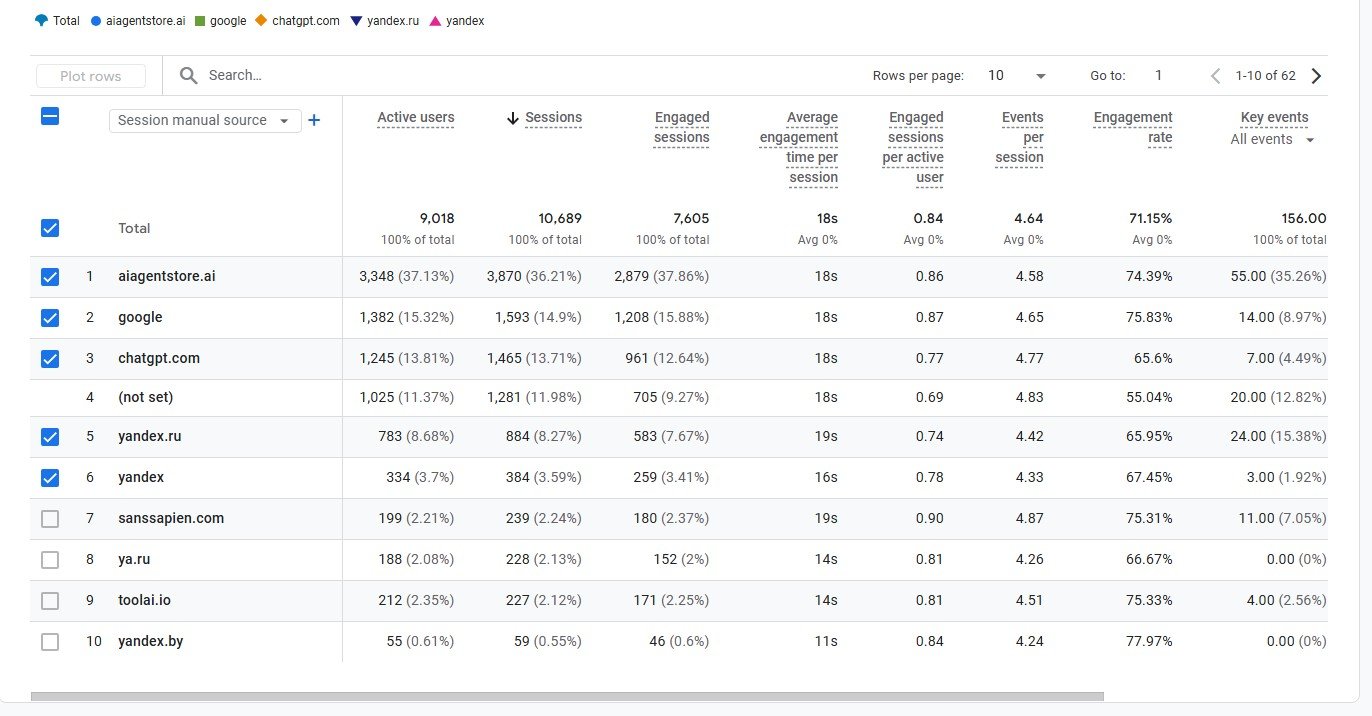
ChatGPT became the third-largest traffic source.

Six pieces published over a 30-day engagement. ChatGPT moved from no measurable referrals to #3 source overall.

GA4 source breakdown: chatgpt.com is the third-largest traffic source with 1,245 active users (13.81%) and 65.6% engagement rate, behind only aiagentstore.ai and google.
Top traffic sources, drilled down from channels to specific source/medium. ChatGPT alone sent 1,245 users in 30 days with 65.6% engagement rate.
1,245 Direct ChatGPT referrals · 30 days
2,414 Total search clicks · 30 days
+77% Active users vs prior month

A 30-day engagement with an AI image generation tool. Six pieces published using the CITE Method. ChatGPT moved from no measurable referrals to the #3 traffic source overall, with 65.6% engagement on those visits. Industry, niche, and competitive density all change the curve. The full case study includes the disclaimer that comes with these numbers.

Read the full case study

What you actually get

Six pieces a month. Three onboarding deliverables. Direct founder access.

Every month

  1. 2 flagship long-forms (2,500+ words each). Original takes, deep research, built to be the best piece on the topic. These earn links and get recommended by ChatGPT.
  2. 4 shorter pieces (1,200–1,800 words each). Built to rank in Google for specific buyer searches or capture buyers comparing options.
  3. Monthly brief. What was published, where it's showing up across Google and AI engines, what's planned next. PDF plus a 30-minute Loom walkthrough.

At onboarding (one-time)

  1. Buyer query map. Every question your buyers ask across Google, ChatGPT, Perplexity, and Reddit. Worth the first month on its own.
  2. Competitor gap report. Where competitors show up that you don't, and where the recoverable gaps are.
  3. 30-day content plan. Publishing roadmap mapped to specific buyer questions and competitive gaps. Refreshed each month based on what moved.

On every account

Direct work with the founder. No account managers. No junior writers. The same person who wrote the methodology runs your account.

Ready to apply for a founding spot?

3 of 5 founding spots are still open. The application takes five minutes. I read every one personally and reply within three business days.

Apply to work together
Pricing

One offer. Visible. Cancel any time.

No contract beyond the current month. No setup fees. No hidden retainers. Founding pricing locks for 12 months even after standard pricing rises.

Founding rate
$2,500 /month

For the first 5 founding clients only. Same scope, same delivery, same operator. Rate locked for 12 months in exchange for permission to publish anonymized results.

3 of 5 founding spots open · Month-to-month, cancel any time
Once all 5 founding clients are signed, the rate moves to $3,500/month. Hard cap of 6 active clients across the agency.

Why month-to-month, no contract

Forcing buyers to commit before they've experienced the work creates resistance and selects the wrong buyers. Month-to-month removes the biggest objection in the sales conversation, signals confidence in the work, and forces me to deliver real value every month. Buyers who would churn anyway churn faster. That's a feature, not a bug.

Read the full scope

Why this is different

Sound familiar?

Five things buyers say on every discovery call. Each one is what this is built to fix.

  1. 01"We're publishing content, but nothing's ranking and nothing's converting."
  2. 02"I tried an agency. Got thirty generic articles a month. Burned."
  3. 03"Our competitors keep getting recommended by ChatGPT. We're invisible there."
  4. 04"I don't have time to brief writers and rewrite everything they send back."
  5. 05"I'm done being locked into year-long retainers I can't pivot out of."
Who I work with

I'm not the right fit for everyone. Better to say that openly.

Work with

  1. You run a B2B SaaS or AI tool company at $500K–$5M ARR
  2. You're founder-led or have a 1–3 person marketing team
  3. You've published content but it's inconsistent, generic, or not converting
  4. You've noticed competitors getting recommended in ChatGPT and you aren't
  5. You take content seriously and accept that real movement compounds over months, not weeks

Turn down

  1. Enterprise with committee buying
  2. Pre-revenue without product-market fit
  3. DTC or e-commerce
  4. "Can you guarantee rankings" as the first question
  5. Companies measuring content by word count or volume
  6. Anyone who wants 20+ pieces a month
Who runs this
Faz, founder of Zilwaris

I'm Faz. Eight-plus years in digital marketing across SaaS and AI tooling. You'll work directly with me, not an account manager.

More about me
Before applying

Honest answers to questions buyers actually ask.

Can you guarantee rankings or AI citations?

No. Anyone who promises specific rankings is selling vapor. I commit to the work and the methodology, not specific outcomes. The whole engagement is month-to-month with cancel-anytime terms. If the work isn't producing value, you stop paying. That's a stronger guarantee than a refund clause.

Do you use AI to write the content?

Yes, openly. AI handles drafting and research. Editing, fact-checking, voice match, and final approval go through me. AI is leverage, not a replacement. Hidden AI use found out kills trust. Disclosed AI use is respected by serious buyers, and the alternative is paying $8K–25K/month for an agency pretending otherwise.

Why only 6 pieces a month?

Six well-built pieces beat thirty generic ones, every time. Volume is a vanity metric. The companies winning in 2026 publish less and think harder. Two flagships and four shorter pieces, every one earning its place. That's the model.

How long until I see results?

Visible movement on tracked questions usually starts in months 2–3. Meaningful movement compounds over months 3–6 as content gets indexed, cited, and reinforced. Less than 90 days isn't a fair test of the methodology. Buyers who can't commit to that mindset are filtered out before signing.

Why $2,500 a month?

Founding pricing for the first 5 clients in exchange for permission to publish anonymized results. Rate is locked for 12 months. After founding spots fill, the rate moves to $3,500. If $2,500 feels too high, the program likely isn't right for the company yet.

Are we locked into a multi-month plan?

No. Each month I deliver the next month's plan based on what moved in the prior month. Plans refresh on a monthly cycle so the work can pivot when something needs to. Cancel any month, no notice required, no penalties.

How is this different from regular SEO?

Traditional SEO optimizes for ranking in Google's blue-link results. This optimizes for being cited inside the answers AI engines generate, while still earning Google rankings on the shorter pieces. Different surfaces, different ranking factors, different content forms. They overlap and reinforce each other when run together. Neither replaces the other.

What if my industry has low AI search volume?

AI search volume in your category matters less than you'd expect. The query mapping finds the buyer-intent questions that exist in your specific niche, not the head-terms with mass volume. Even small B2B categories have buyers asking ChatGPT for recommendations now. What changes is the absolute number of clicks, not whether the methodology works. If your category is truly tiny (under 10K addressable buyers globally), I'll say so on the discovery call rather than take the engagement.

What if I want to cancel?

Cancel any month, no notice required, no penalties. You keep every deliverable produced to date. No retroactive charges. The query map, gap report, content plan, and every piece published are yours.

Can I work with you alongside my existing SEO agency?

Yes, and most clients should. The work operates on different surfaces and reinforces traditional SEO when coordinated. Your SEO agency handles Google ranking on existing pages. I handle new content built for both Google and AI engines. I'll brief them on what I'm publishing where so the playbooks line up. The only friction comes when an SEO agency claims they "already do this" but doesn't have a documented methodology. That's usually a sign they're conflating it with something they already do.

Why aren't there more case studies yet?

Because Zilwaris is new and I cap at 5 founding clients before standard pricing. The published case study is from a parallel engagement on an AI image generation tool. The first B2B SaaS case studies publish once those engagements hit 90 days of measured movement. I'd rather have one honest case study with the disclaimer attached than ten polished ones that overstate what's possible. Founding clients are how the library grows. That's the trade for the locked rate.
Apply for a founding spot.

3 of 5 founding spots still open. Five-minute application. I reply within three business days, every time.

Apply to work together